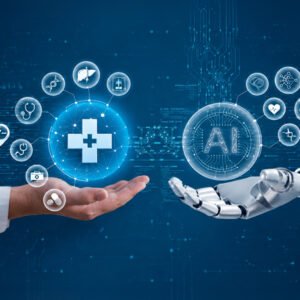
Radiology plays a critical role in modern medicine. Medical imaging techniques such as X-rays, CT scans, MRIs, and ultrasound help doctors diagnose diseases, monitor treatment progress, and plan surgical procedures.
However, radiologists often analyze hundreds of images every day. Reviewing such large volumes of medical data can be time-consuming and complex.
Artificial intelligence and machine learning are beginning to assist radiologists by analyzing medical images and identifying patterns that may indicate disease.
These technologies are designed to support doctors in detecting abnormalities earlier, improving diagnostic accuracy, and reducing the time required to review imaging studies.
What Is AI in Radiology?
AI in radiology refers to the use of machine learning algorithms to analyze medical images and assist doctors in detecting abnormalities.
These algorithms are trained using thousands or even millions of medical images. Over time, the system learns to recognize patterns associated with specific conditions.
For example, an AI system trained on chest X-ray images can learn to identify signs of pneumonia, lung nodules, or tuberculosis.
The goal is not to replace radiologists but to provide an additional layer of analysis that helps doctors review images more efficiently.
How Machine Learning Analyzes Medical Images
Machine learning models analyze imaging data by identifying patterns and features within the image.
When a scan is uploaded to an AI system, the algorithm examines the image and compares it with patterns learned during training.
If the system detects unusual patterns or structures, it highlights those areas for the radiologist to review.
This allows doctors to focus their attention on specific regions of interest within the scan.
AI tools can also help measure tumor size, detect fractures, and identify subtle abnormalities that might otherwise be overlooked.
AI Applications in Radiology
Artificial intelligence is being applied across multiple areas of medical imaging.
Chest Imaging
AI systems are being used to detect lung conditions such as pneumonia, tuberculosis, and lung cancer from chest X-rays and CT scans.
Brain Imaging
Machine learning models can analyze brain scans to detect stroke, tumors, and neurological conditions.
Cancer Detection
AI tools assist in identifying tumors and measuring tumor progression during cancer treatment.
Fracture Detection
Algorithms can analyze X-rays to identify bone fractures, helping doctors detect injuries more quickly.
AI in Hospital Operations
Artificial intelligence is not only used in clinical medicine. It is also improving how hospitals manage operations.
Hospitals often deal with complex workflows involving patient admissions, scheduling, resource allocation, and administrative processes.
AI systems can analyze operational data to help hospitals optimize scheduling, predict patient demand, and manage resources more effectively.
For example, predictive models can estimate patient admission rates, helping hospitals prepare staff and facilities in advance.
Automation tools can also reduce administrative workload by assisting with documentation, billing processes, and appointment management.
These improvements allow healthcare providers to focus more on patient care.
Benefits of AI for Radiologists
AI technology offers several advantages for radiologists and healthcare providers.
One of the most important benefits is efficiency. AI systems can analyze images quickly, allowing radiologists to review cases faster.
AI can also improve consistency by identifying patterns in medical images that may be difficult to detect manually.
In high-volume diagnostic centers, AI tools can help prioritize urgent cases and ensure that critical findings receive immediate attention.
By supporting radiologists in analyzing imaging data, artificial intelligence can contribute to faster diagnosis and improved patient care.
Challenges and Limitations
Despite its potential, AI in radiology still faces several challenges.
AI algorithms require large and diverse datasets to function accurately. If the training data is limited or biased, the system may produce inaccurate results.
Regulatory approval and clinical validation are also important before AI tools can be widely adopted in healthcare.
Another important factor is transparency. Doctors need to understand how AI systems arrive at certain conclusions before relying on them in clinical practice.
For these reasons, AI tools are currently used as decision support systems rather than independent diagnostic tools.
The Future of AI in Medical Imaging
Artificial intelligence is expected to play a larger role in medical imaging over the coming years.
As algorithms improve and more medical data becomes available, AI systems may become more accurate and reliable.
Integration with hospital information systems and electronic health records could allow AI tools to analyze both imaging data and clinical history to support diagnosis.
Collaboration between radiologists, researchers, and technology companies will continue to shape how AI is used in radiology and diagnostic medicine.
Key Takeaways
AI is helping radiologists analyze medical images more efficiently.
Machine learning algorithms detect patterns in X-rays, CT scans, and MRIs.
AI tools assist doctors in identifying diseases such as cancer, stroke, and fractures.
Artificial intelligence improves workflow efficiency in diagnostic centers.
AI works as a decision support tool rather than a replacement for medical professionals.