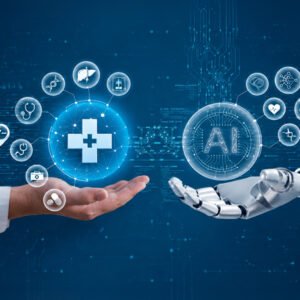
Artificial intelligence is becoming one of the most influential technologies in modern healthcare. Hospitals, researchers, and healthcare companies are exploring how machine learning systems can assist doctors, improve diagnostic accuracy, and streamline hospital operations.
Healthcare generates enormous amounts of data every day. Medical imaging, laboratory reports, patient records, and clinical research produce information that can be difficult to analyze quickly.
Artificial intelligence systems are designed to analyze large datasets, identify patterns, and support clinical decision making. While AI does not replace medical professionals, it can assist doctors by providing insights that help improve patient care.
Across the healthcare ecosystem, artificial intelligence is being used in areas such as diagnostics, treatment planning, drug discovery, hospital management, and remote patient monitoring.
AI in Medical Diagnostics
One of the most significant uses of artificial intelligence in healthcare is medical diagnostics.
Machine learning algorithms can analyze medical images such as X-rays, CT scans, and MRIs to detect abnormalities. These systems are trained using thousands of medical images and can learn to identify patterns associated with specific diseases.
In radiology and pathology, AI tools can assist doctors by highlighting suspicious areas in scans or slides. This allows clinicians to review images more efficiently and focus on cases that require immediate attention.
Several healthcare technology companies are developing AI solutions that support radiologists in identifying conditions such as lung disease, fractures, tumors, and neurological disorders.
AI assisted diagnostics can help reduce diagnostic errors and improve early detection of diseases.
Artificial Intelligence in Treatment Planning
AI is also playing an increasing role in treatment planning.
By analyzing patient data, clinical records, and medical research, AI systems can assist doctors in identifying treatment options that are most likely to be effective for a particular patient.
In oncology, for example, AI platforms are being used to analyze genetic information and tumor characteristics to support personalized cancer treatment strategies.
These systems help doctors review large volumes of research data quickly and identify relevant treatment approaches.
Although final medical decisions always remain with healthcare professionals, AI can serve as a valuable decision support tool.
AI in Drug Discovery and Medical Research
Developing new medicines is a complex process that often takes many years.
Artificial intelligence is helping pharmaceutical researchers analyze biological data and identify potential drug candidates more efficiently.
AI systems can examine chemical structures, genetic data, and clinical trial results to predict how certain compounds may interact with biological targets.
This technology can significantly accelerate the early stages of drug discovery and help researchers identify promising treatment options faster.
Pharmaceutical companies and research institutions are increasingly investing in AI driven drug development platforms.
AI in Hospital Operations
Artificial intelligence is not only used in clinical medicine. It is also improving how hospitals manage operations.
Hospitals often deal with complex workflows involving patient admissions, scheduling, resource allocation, and administrative processes.
AI systems can analyze operational data to help hospitals optimize scheduling, predict patient demand, and manage resources more effectively.
For example, predictive models can estimate patient admission rates, helping hospitals prepare staff and facilities in advance.
Automation tools can also reduce administrative workload by assisting with documentation, billing processes, and appointment management.
These improvements allow healthcare providers to focus more on patient care.
Remote Patient Monitoring and Digital Health
Another important application of artificial intelligence is remote patient monitoring.
Wearable health devices and digital health platforms can collect data such as heart rate, activity levels, sleep patterns, and other health indicators.
AI systems analyze this data to detect patterns that may indicate potential health issues.
Doctors can use these insights to monitor patients with chronic diseases such as diabetes, heart conditions, or respiratory disorders.
Early detection of health changes allows medical professionals to intervene before conditions worsen.
Remote monitoring technologies are becoming increasingly important as healthcare systems focus on preventive care and long term disease management.